
Before a woman running a small food business can think about sales, orders, or expansion, she may already have cooked for her family, cleaned the house, gotten children ready for school, and checked on an older relative. By the time she turns to her business, much of her day is gone. This scene plays out every morning across ASEAN, in urban home workshops and rural market stalls, from Jakarta to Hanoi to Manila. That hidden loss of time is one of the least visible constraints on women-led businesses across ASEAN, and one of the most consequential.
Women entrepreneurs across the region, particularly those running micro, small, and medium enterprises (MSMEs), are a significant economic force. Female business ownership in the Philippines exceeds 55%, and in Indonesia it reaches nearly 65%, far above global averages (OECD, 2025). Women-led MSMEs contribute to the vast majority of businesses across ASEAN Member States, driving employment and local economic activity at every level.
Yet behind these numbers lies a barrier that rarely makes it into policy discussions: the enormous amount of unpaid care and domestic work that women carry every day. Cooking, cleaning, raising children, and looking after elderly or sick family members, this work is essential for families and communities, yet it remains invisible in economic data and largely absent from the policies meant to support business growth (Oxfam International, 2020). This article examines how that hidden burden shapes the lives of women entrepreneurs across ASEAN. It explores the nature of care work, how unpaid care work manifests in the lives of women entrepreneurs, the multiple impacts on their businesses and well-being, and the policy and structural alterations required to address this hidden barrier to women’s economic empowerment.
What Constitutes Unpaid Care Work?
Unpaid care work encompasses the range of activities that sustain households and communities yet remain outside the formal economy. The International Labour Organization (2018) defines unpaid care work as non-remunerated work carried out to sustain the well-being, health, and maintenance of other individuals in a household or community. It includes both direct and indirect care, such as routine housework. This definition draws on the newly adopted international statistical definition of work and its various forms, reflected in the revised International Classification of Activities for Time Use Statistics (ICATUS), which facilitates the production of comparable time-use statistics across countries and over time (International Labour Organization, 2018).
To speak of unpaid care and domestic work, the work so often shouldered by women, is to speak of something essential yet persistently invisible. Women hold key positions in the labor force, in entrepreneurship, and in the larger economy. Yet they carry an additional burden: the biological and social reproductive work performed largely within households and families, most of which remains unpaid. This work, carried out within the framework of social relations, of family, of kinship, of obligation, is systematically excluded from macroeconomic calculations. Care work within the family is not counted as productive labor, nor is it understood as contributing to the economy. This invisibility results in an excessive workload for women and a substantial lack of recognition for the work of care itself (Sigiro et al., 2018).
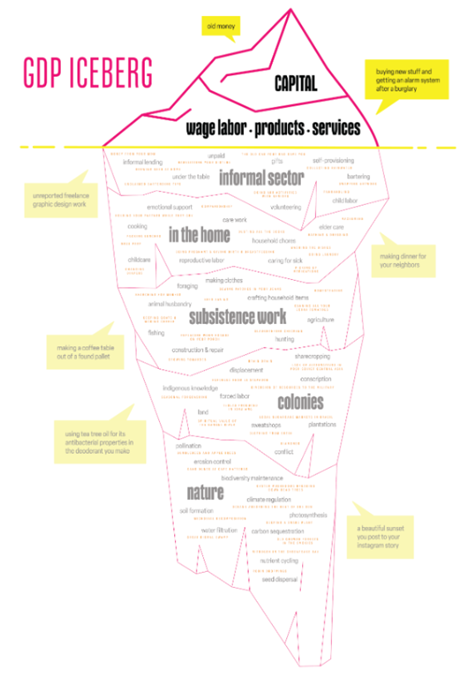
At its core, unpaid care work functions as a hidden pillar of economic growth. It is fundamental to keeping society functioning: the daily and generational renewal of households, communities, and the labour force itself. Thus, it supports the entire economy from below the waterline, an unseen base upon which all else rests.
The neglect of unpaid care work, particularly unpaid childcare and domestic labor, has been also criticized by economists such as Stiglitz, Sen, and Fitoussi (2009, as cited in Sigiro et al., 2018). They argue that the value of household production in France, Finland, and the United States amounted to between 30 and 35 percent of GDP in those countries from 1995 to 2006. In developing countries, they estimate the economic value of household work is even more significant, given the greater reliance on household-based agricultural production.
Source: leeturnerdesign.com
The metaphor of the iceberg is apt. Above the waterline lies the visible economy: GDP, exports, formal employment, capital and/or corporate profits. This is what economists measure, what policymakers target, and what headlines report. Though beneath the surface, supporting the entire structure, lies the vast submerged mass of unpaid care and domestic work. Without this hidden foundation, the visible economy would collapse. Workers would not arrive at factories rested and fed. Children would not develop into capable adults. The sick and elderly would have no one to tend them. Yet this primary work remains invisible in economic accounting, unvalued in policy models, and unrecognized as “real work.”
How Unpaid Care Work Manifests Among Women MSMEs in ASEAN
1. Double Burden Responsibility and Flexibility Trap
Women entrepreneurs in ASEAN experience the “double burden” not as two separate spheres of activity but as an integrated daily negotiation. The businesses women run, often micro-enterprises in food processing, handicrafts, beauty services, and retail, frequently operate from home, blurring the boundaries between workspace and domestic space. While this arrangement gives flexibility to combine earning with caring, it also means that women never truly leave work, whether paid or unpaid. Women’s gendered domestic roles do not end when they clock out from paid work; rather, they are expected to perform care work both before and after their formal employment. This continuous cycle means that the flexibility of home-based work becomes a trap: it allows women to be perpetually available for both productive and reproductive labor, yet it also ensures that they never experience a clear separation between work and rest.
Globally, an estimated 21.7 percent of working-age women (606 million) perform unpaid care work on a full-time basis, compared with only 1.5 percent of men (41 million) (ILO, 2019, as cited in ESCAP & ASEAN, 2021). Time-use data from 64 countries, representing 66.9 percent of the world’s working-age population, show that 16.4 billion hours are spent in unpaid care work every day (ILO, 2018, as cited in ESCAP & ASEAN, 2021). These global patterns are mirrored in Southeast Asia, where the disparity between women and men remains striking and persistent.
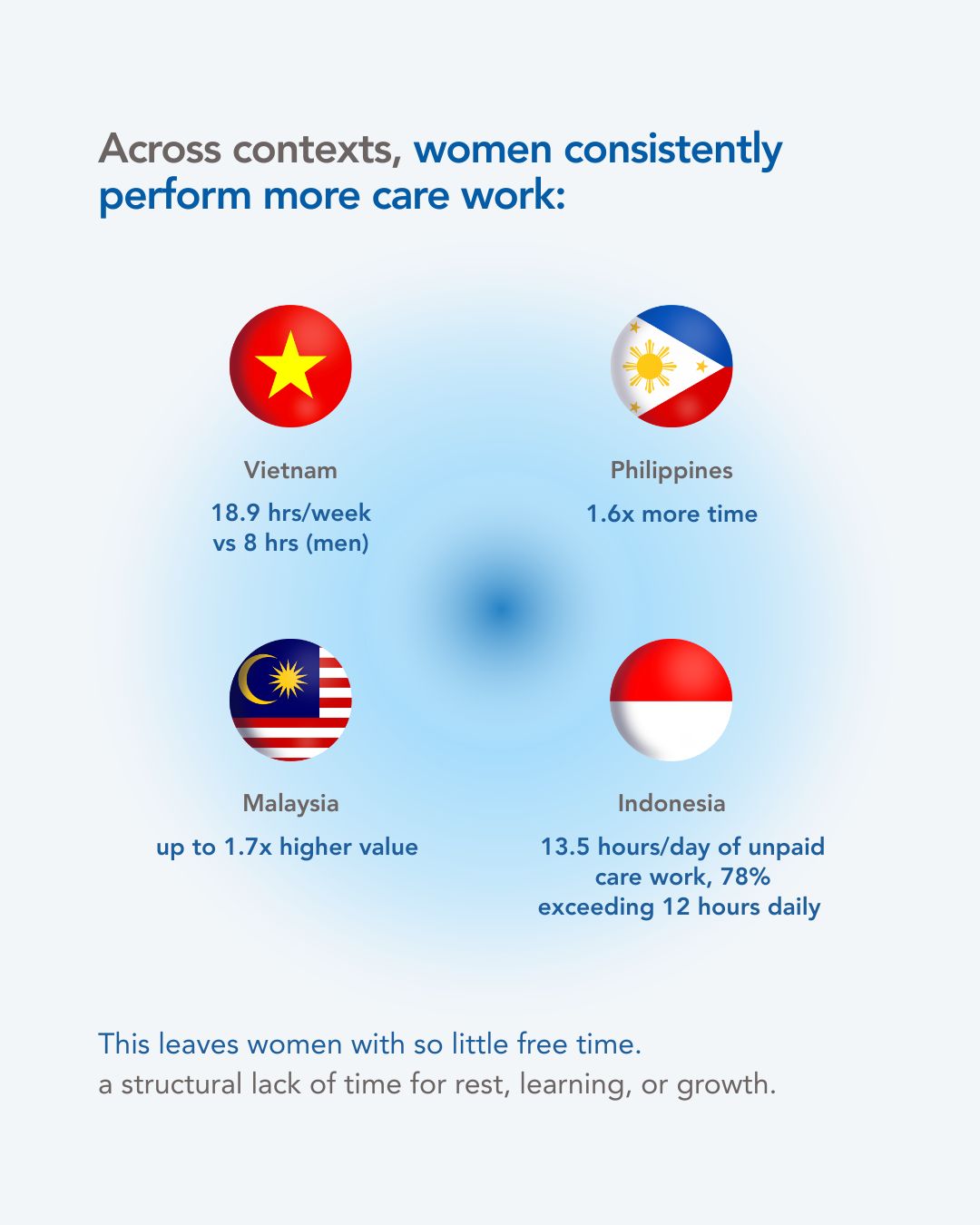
As documented also in the 2021 ESCAP-ASEAN report Addressing Unpaid Care Work in ASEAN, while comparable time-use data still is limited throughout Member States, available studies and small surveys from individual countries reveal a consistent pattern of women bearing a disproportionately heavy burden of unpaid care and domestic responsibilities (ESCAP & ASEAN, 2021). The report synthesizes findings from multiple national studies to paint a picture of this disparity:
- In Viet Nam, women perform 18.9 hours of unpaid care and domestic work per week, compared to eight hours for men—more than double—while both do roughly the same amount of paid work (ILO, 2021, as cited in ESCAP & ASEAN, 2021).
- In Malaysia, a 2019 study found women’s unpaid care labor value at 1.6 times that of men for primary activities and 1.7 times when secondary activities were included, revealing that women’s care contributions reach far beyond what is captured in primary task measurements (Khazanah Research Institute, 2019, as cited in ESCAP & ASEAN, 2021).
- In the Philippines, preliminary findings from the 2021 National Household Care Survey indicate that women spend 1.6 times more time on unpaid care work than men, a disparity that directly affects their capacity to engage in productive economic activities (Philippine Commission on Women et al., 2021, as cited in ESCAP & ASEAN, 2021).
- In Cambodia and Thailand, women spend just short of 50 percent of their working time on household chores and care, pointing to the substantial portion of paid work they also must balance alongside their unpaid responsibilities (Charmes, 2019, as cited in ESCAP & ASEAN, 2021).
- In Indonesia, Time-use data in Indonesia remains limited. The 2018 national survey by Jurnal Perempuan across 34 provinces found that housewives worked an average of 13.5 hours per day on care and domestic tasks (SD = 2.5 hours), nearly double the average working hours of women in Asia-Pacific (7.7 hours) documented by ILO studies (Sigiro et al., 2018; ESCAP, 2019). Significantly, 78 percent of respondents reported working more than 12 hours daily on unpaid care work, with only 6 percent working eight hours or less (Sigiro et al., 2018). This differs noticeably with earlier data from a 2004–2005 urban pilot study covering only 360 households, which used 24-hour time diaries but was not nationally representative (ILO & UNDP, 2018, as cited in ESCAP & ASEAN, 2021), pointing to the long-standing data gap that the 2018 survey began to address.
2. Having So Little Time That Growth Becomes Impossible
There is also the reality of having so little free time that rest, learning, and planning become almost impossible, and this is a defining feature of women entrepreneurs’ lives in Southeast Asia. For women entrepreneurs, this translates directly into business constraints. Unpaid care work indirectly but powerfully limits women entrepreneurs’ access to finance through multiple pathways. First, having so little free time means women have less opportunity to build relationships with bankers, understand financial products, or navigate complex loan application processes. Second, women’s concentration in informal, home-based businesses (UN ESCAP, 2018; Zuan et al., 2024) means they lack the registration documents and formal records that financial institutions require.
Fillaili et al. (2022) found that more than 60% of women-owned MSMEs in Indonesia faced difficulties accessing finance due to high repayment risk, high interest rates, and having too many outstanding loans. However, statistically significant gender differences emerged regarding collateral: a higher proportion of men-owned MSMEs reported lack of collateral (67.5%) and undervalued collateral (68.1%) as barriers compared to women-owned MSMEs.
This finding shows an intriguing paradox. On the surface, it appears that men encounter collateral-related obstacles more frequently than women. However, rather than indicating that women face fewer barriers, the disparity likely reflects a deeper structural issue: women may self-select out of formal financing channels precisely because they anticipate being unable to meet collateral requirements. In many Southeast Asian contexts, women are less likely to hold assets such as land or property in their own name due to patriarchal inheritance systems, marital property norms, and constrained access to formal asset registration. Consequently, when asked to identify barriers, women may not list “lack of collateral” simply because they never advance far enough in the loan application process to confront that requirement directly. This subtle but critical distinction suggests that aggregate statistics can understate the true extent of women’s exclusion from formal finance.
Source: makemothersmatter.org
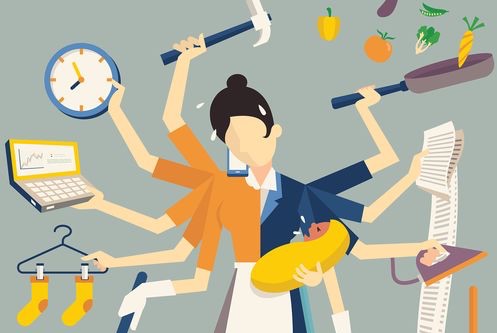
Having so little free time that rest, learning, and planning become almost impossible pervades women entrepreneurs’ lives and does more than exhaust their physical and mental reserves. It actively severs the particular conditions under which learning, experimentation, and growth become possible. Historically, the concept of leisure has never been simply about rest; it has been understood as the necessary space for reflection, skill acquisition, and the cultivation of new capacities. For women whose days are carved into fragments by unpaid care work, that space simply does not exist. Without contiguous, uninterrupted time, learning a new e-commerce platform, learning to interpret financial statements, or even attending a business workshop becomes an unattainable luxury. The result is a self-perpetuating cycle. This lack of free time similarly constrains the adoption of digital technologies, as learning to use e-commerce platforms or digital marketing tools requires the uninterrupted time that women with heavy care responsibilities rarely have.
When women entrepreneurs remain locked out of the potential to grow because the double burden of paid and unpaid work leaves them no leisure time, they are locked out of the very opportunities that are able to streamline their work and eventually free up time. In this way, having no time to spare is not just a barrier to growth. It is a mechanism that reproduces the very informality and precarity that keep women’s businesses small, their collateral undervalued, and their voices unheard in the rooms where credit decisions are made.
Shifting the Weight: The Case for Care-Sensitive Policies
The overlaps between women’s paid work and unpaid care work must be central to policy formulation (ESCAP & ASEAN, 2021). Confronting this challenge requires more than well-intentioned business training programmes and credit schemes. It demands a fundamental shift in how societies value, recognize, and redistribute care work.
A significant policy development occurred in October 2021, when ASEAN adopted the ASEAN Comprehensive Framework on Care Economy (ASEAN, 2021). The Framework emerged in response to the disruptions resulting from the COVID-19 pandemic and aims to guide ASEAN’s development of the care economy in response to complex crises and challenges, such as the impacts of the COVID-19 pandemic, changing demographics, the climate crisis, to further sustainable development and protect different segments of populations and sectors in the region. It calls for a multi-faceted, whole-of-ASEAN approach including infrastructure, social protection, services, and labour policies.
The Framework signifies a collective recognition that care can no longer be treated as a private, family matter. It provides a strategic roadmap for governments to place care at the centre of public policy, and it calls for a whole-of-ASEAN approach that spans infrastructure, social protection, services, and labour policies.
In the same year, the United Nations Economic and Social Commission for Asia and the Pacific (ESCAP) and ASEAN jointly published a report titled Addressing Unpaid Care Work in ASEAN (ESCAP & ASEAN, 2021). The report provides a systematic analysis of the gendered distribution of unpaid care work across the region and translates the Framework’s broad goals into concrete policy directions. It outlines four categories of care-sensitive policies: care infrastructure (such as water, sanitation, energy, and transport), care-related social protection transfers and benefits (including cash transfers, tax benefits, and non-contributory pensions), care services (childcare, elder care, and care for persons with disabilities or chronic illness), and employment-related care policies (leave entitlements, flexible work arrangements, and social security provisions) (ESCAP & ASEAN, 2021). Each category addresses a specific dimension of the care burden and collectively they form a framework for shifting responsibility for care from individual women to the State, markets, and communities.
Without a systematic policy response, the unpaid care burden will remain a structural barrier that locks women entrepreneurs into informality, low productivity, and constrained growth. The four categories of care-sensitive policies form a coherent framework for redistributing responsibility away from individual women and toward institutions that can provide sustainable solutions. Yet the gap between policy adoption and meaningful implementation remains wide. Translating these frameworks into tangible change requires sustained political will, the allocation of adequate public resources, and a recognition that care work is not a private cost but a public good. For ASEAN, where women-owned MSMEs already contribute substantially to employment and economic dynamism, investing in care is an investment in the region’s productive potential. When women are freed from the disproportionate weight of unpaid care responsibilities, they can move from survival-oriented self-employment to business growth, innovation, and market expansion. The question is whether policymakers will move decisively to transform care from an invisible burden into a shared social foundation.
Conclusion
The woman who started her day long before her shop opened, whether in a Jakarta neighbourhood, a rural village in Vietnam, or a market town in the Philippines, is not an exception. Her story is shared by millions across ASEAN, and it points to something that economic data rarely captures: before women entrepreneurs can think about growth, they are already working. That prior, invisible labour does not disappear when the shop opens. It accumulates, day after day, quietly draining the time, energy, and mental space that building a business requires. In this sense, unpaid care work is not a background condition—it is an active constraint, one that shapes every decision a woman entrepreneur makes, from which opportunities she pursues to which ones she never gets to consider at all.
What is needed now is a genuine shift in mindset across institutions, communities, and households. Care is a shared responsibility, not a default role assigned to women. The unpaid labour of women subsidizes the formal economy, absorbing costs that would otherwise fall on the State or employers. For women entrepreneurs, that subsidy is extracted from the hours they could have spent scaling their businesses, accessing finance, or simply resting. Embedding care-sensitive perspectives into every level of economic planning, from business development programmes, policies to national budgets, is not just a matter of gender justice. A truly resilient ASEAN economy cannot be built on the unacknowledged labour of its women.
References:
- ASEAN. (2021). ASEAN comprehensive framework on care economy. Association of Southeast Asian Nations.
- Association of Southeast Asian Nations. (n.d.). Development of micro, small and medium enterprises (MSME) in ASEAN. https://asean.org/our-communities/economic-community/resilient-and-inclusive-asean/development-of-micro-small-and-medium-enterprises-in-asean-msme/
- Economic and Social Commission for Asia and the Pacific, & Association of Southeast Asian Nations. (2021). Addressing unpaid care work in ASEAN.https://www.unescap.org/kp/2021/addressing-unpaid-care-work-asean
- Fillaili, R., Kusumawardhani, N., Larasati, W., Sawiji, H. W., Anshary, F., Soufi, M., Gemilang, C., Putri, R. D., & Pertiwi, U. M. (2022). Men- and women-owned/led MSMEs and the COVID-19 policy responses in Indonesia. The SMERU Research Institute.
- International Labour Organization. (2018).Care work and care jobs for the future of decent work.https://www.ilo.org/wcmsp5/groups/public/—dgreports/—dcomm/—publ/documents/publication/wcms_633135.pdf
- OECD. (2025). Women entrepreneurship in remote areas in Indonesia and the Philippines. OECD Global Relations Policy Papers.
- Oxfam International. (2020). Time to care: Unpaid and underpaid care work and the global inequality crisis.https://doi.org/10.21201/2020.5419
- Sigiro, A. N., Primaldhi, A., & Takwin, B. (2018). Ekonomi perawatan dan beban kerja ibu rumah tangga di Indonesia [Care economy and the burden of housewives’ work in Indonesia].Jurnal Perempuan,23(4), 249–258.
- United Nations Economic and Social Commission for Asia and the Pacific. (2019). Unpaid work in Asia and the Pacific (Social Development Policy Paper No. 2019/02).
- United Nations Economic and Social Commission for Asia and the Pacific. (2018). Fostering women’s entrepreneurship in ASEAN: Transforming prospects, transforming societies. ST/ESCAP/2784.
- Zuan, H., Abd Razak, M. F., & Ramli, I. M. (2024). Empowering micro businesses in Southeast Asia: Addressing challenges and harnessing opportunities for ASEAN economic integration(Policy Brief). Economic Research Institute for ASEAN and East Asia.